Spider mites
GENERAL INFORMATION
According to biological classification, spider mites are a family of arachnids, which includes at least 1,300 species.
It is difficult to see the animal without a microscope.
The size of an adult reaches only 0.15 mm. The body is yellowish with a brown tint.
It is thickened in the middle part, and narrows towards the back end. The pest has 2 pairs of legs.
It is difficult to see the animal without a microscope.
The size of an adult reaches only 0.15 mm. The body is yellowish with a brown tint.
It is thickened in the middle part, and narrows towards the back end. The pest has 2 pairs of legs.

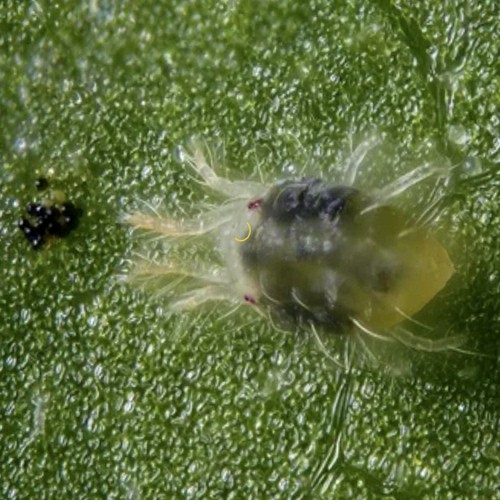

photo from the internet
DIAGNOSTICS
The most obvious symptom is a silvery web, which, in case of severe infestation, covers the entire plant. At first, when the colony is small, the web is almost invisible.
This fact often confuses novice gardeners, who believe that if there is no web, there is no mite.
The mite sucks nutrients from the plant, piercing the surface of the leaf with a sharp proboscis.
Around these punctures, the surface tissue of the leaf blade dies and looks like microscopic light yellow or green dots. Subsequently, the dots merge into larger spots. Migrating along the plant, the spider mite leaves its excrement. They look like small black grains and are easily separated from the plant.
This fact often confuses novice gardeners, who believe that if there is no web, there is no mite.
The mite sucks nutrients from the plant, piercing the surface of the leaf with a sharp proboscis.
Around these punctures, the surface tissue of the leaf blade dies and looks like microscopic light yellow or green dots. Subsequently, the dots merge into larger spots. Migrating along the plant, the spider mite leaves its excrement. They look like small black grains and are easily separated from the plant.
CONTROL THE
NUMBER OF
NUMBER OF
The key to success is compliance with agricultural technology:
1 Removal of weeds and fallen leaves, since some species overwinter on fallen leaves. 2 Mandatory burning of vines remaining after autumn pruning.
Modern chemical preparations allow you to effectively combat spider mites and gall mites on grapes.
Among the preparations are: Thiovit Jet, Actofit, BI-58
1 Removal of weeds and fallen leaves, since some species overwinter on fallen leaves. 2 Mandatory burning of vines remaining after autumn pruning.
Modern chemical preparations allow you to effectively combat spider mites and gall mites on grapes.
Among the preparations are: Thiovit Jet, Actofit, BI-58