Bronze beetle
GENERAL INFORMATION
The beetles are very voracious, they destroy the flowers of fruit and berry and ornamental crops, suck the juices out of plants, leaving behind yellowed areas, and gnaw off leaves.
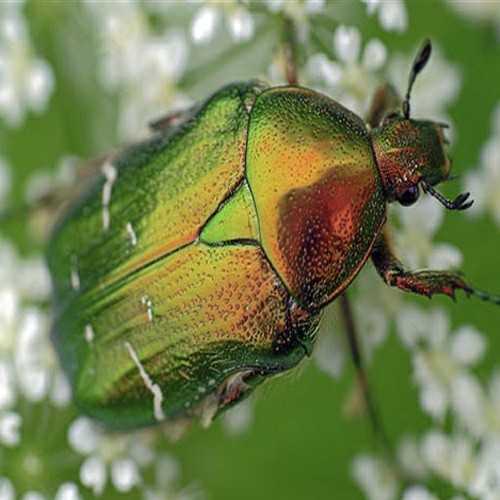
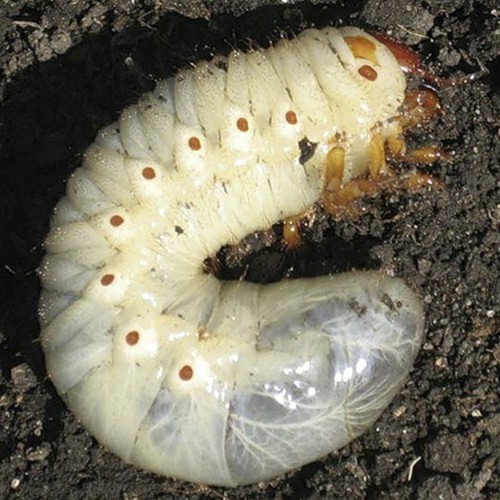
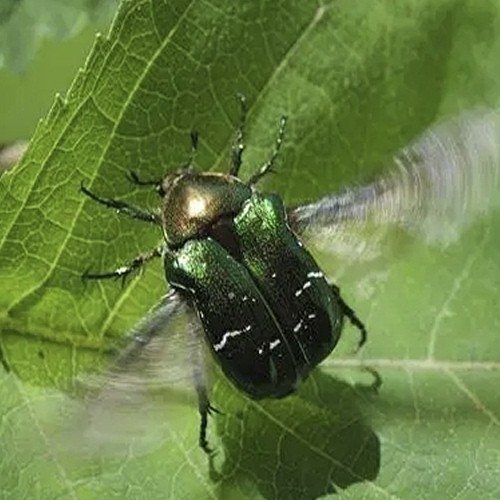
photo from the internet
DIAGNOSTICS
The body length is 13-22.5 mm, the width is 8-11.3 mm. The body of the beetles is oblong-oval, slightly convex, quite wide. In most individuals it is somewhat narrowed towards the back. The top of the body is mostly covered in hairs, less often naked.
The color is changeable. The upper side of the body is mainly bright green, golden-green, with a more or less pronounced copper-red tint, always with a metallic sheen. The antennae are black. The clypeus (clypeus) is oblong, quadrangular, densely covered with large dots.
The clypeus is slightly widened towards the front.
The anterior corners of the clypeus are widely rounded and slightly raised. In the middle of the clypeus there is a rather deep rounded-triangular notch. On the sides along the entire length of the clypeus there are raised blunt ribs and lateral lobes moderately protruding outward.
The rest of the head is covered with denser and deeper dots than on the clypeus. In the middle of the head there is a more or less strong longitudinal keel.
The color is changeable. The upper side of the body is mainly bright green, golden-green, with a more or less pronounced copper-red tint, always with a metallic sheen. The antennae are black. The clypeus (clypeus) is oblong, quadrangular, densely covered with large dots.
The clypeus is slightly widened towards the front.
The anterior corners of the clypeus are widely rounded and slightly raised. In the middle of the clypeus there is a rather deep rounded-triangular notch. On the sides along the entire length of the clypeus there are raised blunt ribs and lateral lobes moderately protruding outward.
The rest of the head is covered with denser and deeper dots than on the clypeus. In the middle of the head there is a more or less strong longitudinal keel.
CONTROL THE
NUMBER OF
NUMBER OF
Methods of getting rid of bronze beetles:
It is recommended to collect them manually in the morning, when they are not very active yet.
Plowing the soil after winter will destroy the beetles that are in the soil at this time.
Spraying with decoctions and infusions of herbs that repel pests, such as dandelion, tansy, wormwood, garlic, horseradish, onions, etc.
It is recommended to collect them manually in the morning, when they are not very active yet.
Plowing the soil after winter will destroy the beetles that are in the soil at this time.
Spraying with decoctions and infusions of herbs that repel pests, such as dandelion, tansy, wormwood, garlic, horseradish, onions, etc.