Black spot
GENERAL INFORMATION
Black spot, known as shoot dieback disease or bark cracking, affects all above-ground plant organs: green leaves, shoots, tendrils, inflorescences, clusters, as well as lignified annual shoots, perennial branches and bush trunks.
The causative agent of black spot is the fungus Phomopsis viticola Sacc.
The causative agent of black spot is the fungus Phomopsis viticola Sacc.
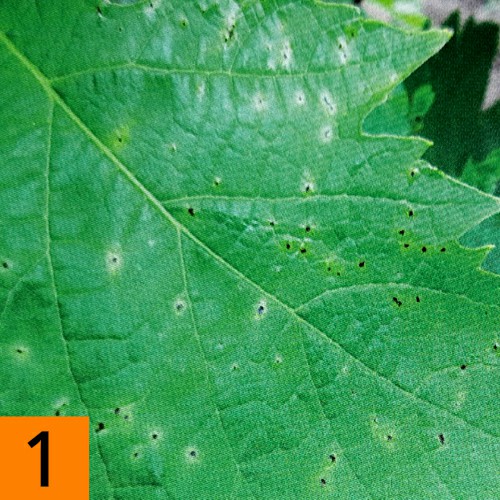

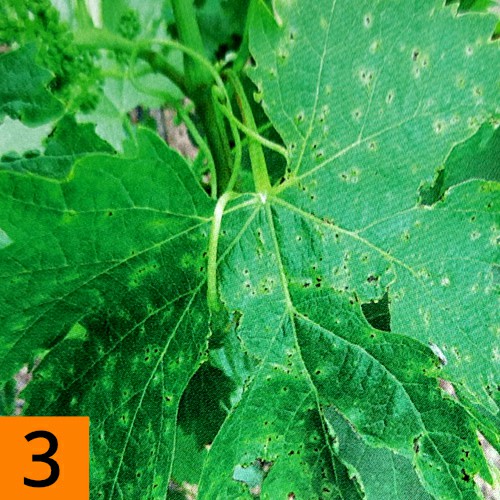

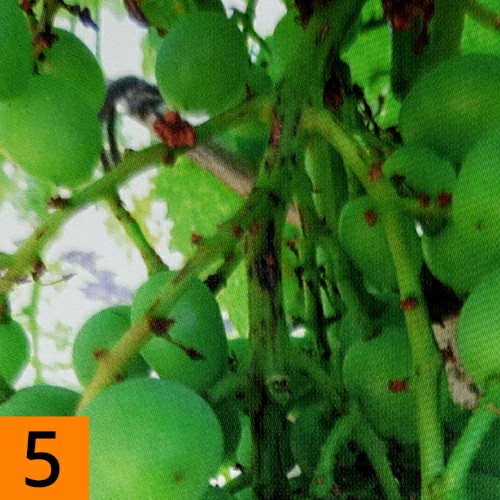
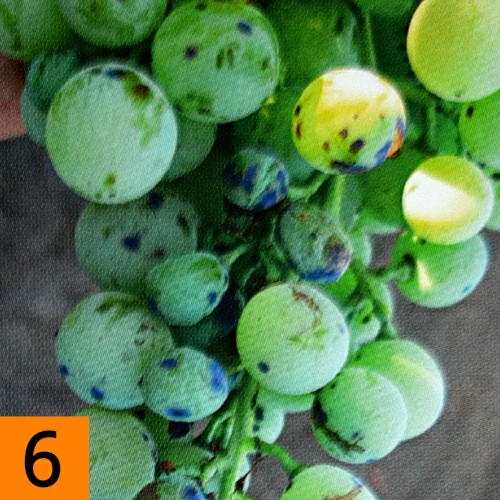
photo from the internet
DIAGNOSTICS
The first signs of black spot appear when the plant already has two or three leaves and the inflorescences begin to emerge.
Numerous small, initially chlorotic, spots with a dark center appear on the leaves; over time, dark brown or black necrosis increases, mostly near a more powerful vein, which is also partially or completely dark (photo 1, 2).
The leaf tissue is deformed, tears and holes appear, and the leaves turn yellow prematurely (photo 3).
Green shoots begin to be affected by black spot in early spring, in the 3-5 leaf phase. As the shoots thicken, the bark cracks longitudinally and ulcers form (photo 4).
Dark brown or black spots in the form of strokes appear on the ridges of inflorescences and bunches, growing berries when they are affected by black spot, which, growing, cause the death of individual parts of the ridge and the withering of berries (photo 5, 6).
Numerous small, initially chlorotic, spots with a dark center appear on the leaves; over time, dark brown or black necrosis increases, mostly near a more powerful vein, which is also partially or completely dark (photo 1, 2).
The leaf tissue is deformed, tears and holes appear, and the leaves turn yellow prematurely (photo 3).
Green shoots begin to be affected by black spot in early spring, in the 3-5 leaf phase. As the shoots thicken, the bark cracks longitudinally and ulcers form (photo 4).
Dark brown or black spots in the form of strokes appear on the ridges of inflorescences and bunches, growing berries when they are affected by black spot, which, growing, cause the death of individual parts of the ridge and the withering of berries (photo 5, 6).
TREATMENT
The system of protective measures against black spot is aimed at reducing the harmfulness of the disease and includes:
Agrotechnical (removal and burning of vines, timely breaking off, etc.)
Chemical (spraying with fungicides)
Biological (introduction of resistant varieties) Optimal timing of specialized protective measures are:
Single spraying in the phase of 3-5 leaves
Double spraying in the phases of "bud break" "3-5 leaves"
Triple spraying in the phases of "bud break", "3-5 leaves"
Highly effective for protection against black spot are the following fungicides: Pergado M. VDG, Quadris, SK.
Agrotechnical (removal and burning of vines, timely breaking off, etc.)
Chemical (spraying with fungicides)
Biological (introduction of resistant varieties) Optimal timing of specialized protective measures are:
Single spraying in the phase of 3-5 leaves
Double spraying in the phases of "bud break" "3-5 leaves"
Triple spraying in the phases of "bud break", "3-5 leaves"
Highly effective for protection against black spot are the following fungicides: Pergado M. VDG, Quadris, SK.