White rot
GENERAL INFORMATION
White rot is common in all viticulture regions, but its outbreaks are most often observed in areas with high humidity.
Grape bunches affected by white rot lose their marketable appearance and become unsuitable for storage and technological processing.
Grape bunches affected by white rot lose their marketable appearance and become unsuitable for storage and technological processing.
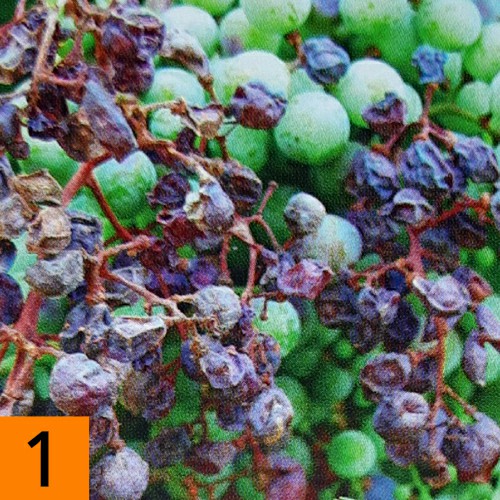
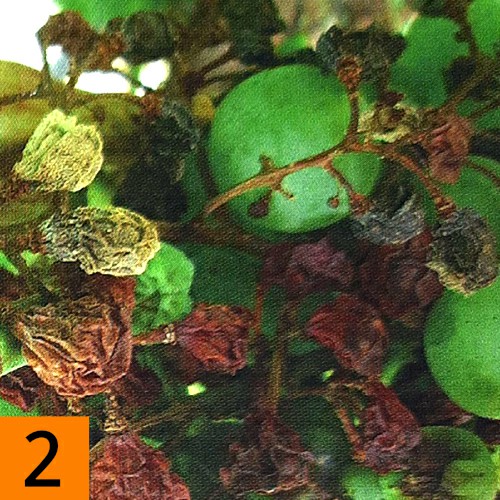
photo from the internet
DIAGNOSTICS
Typical symptoms of white rot develop on the ridges and berries of grapes several days after heavy rainfall, especially hail. White rot affects the entire bunch at once, not individual berries. Affected ridges begin to dry out. The berries turn yellow, then acquire a pink-blue hue, which begins to appear on the side of the stalk, lose turgor, and dry out (photo 1).
Numerous pycnidia ripening under the cuticle lift it above the surface of the berry epidermis, resulting in a cavity between the cuticle and the epidermis.
Air penetrating into this cavity causes an optical effect that gives the affected berries a white color.
The surface of the berries, and often the stalks, is covered with numerous dirty white bumps - pycnidia (photo 2).
Numerous pycnidia ripening under the cuticle lift it above the surface of the berry epidermis, resulting in a cavity between the cuticle and the epidermis.
Air penetrating into this cavity causes an optical effect that gives the affected berries a white color.
The surface of the berries, and often the stalks, is covered with numerous dirty white bumps - pycnidia (photo 2).
TREATMENT
The need for special protective measures arises rarely.
Preparations used against mildew and black rot also protect plants from white rot. An important measure for preventing white rot is to exclude contact of bunches and berries with the soil.
Good efficiency in protecting against white rot is shown by treatment of vineyards with contact fungicides based on folpet, thiram, the systemic preparation Horus, as well as botryticide Switch.
Good efficiency in protecting against white rot is shown by treatment of vineyards with contact fungicides based on folpet, thiram, the systemic preparation Horus, as well as botryticide Switch.