Black rot
GENERAL INFORMATION
Black rot of grapes is a group of diseases that can develop only on grapevines.
Black rot is often considered a secondary disease, but in some years it can be widespread and lead to a loss of up to 80% of the harvest, mainly due to damage to grape berries.
All vegetative and generative organs of the grapevine are susceptible to black rot as soon as they enter the active growth phase.
Damage to grapes by this disease leads to a decrease in the qualitative and quantitative indicators of the harvest, loss of the marketable appearance of bunches and negatively affects the quality of wines made from affected berries.
All vegetative and generative organs of the grapevine are susceptible to black rot as soon as they enter the active growth phase.
Damage to grapes by this disease leads to a decrease in the qualitative and quantitative indicators of the harvest, loss of the marketable appearance of bunches and negatively affects the quality of wines made from affected berries.
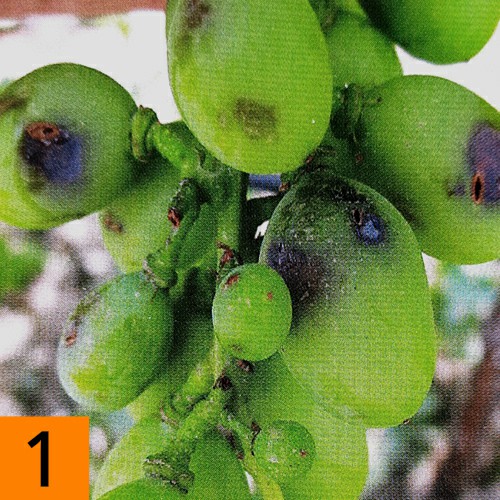

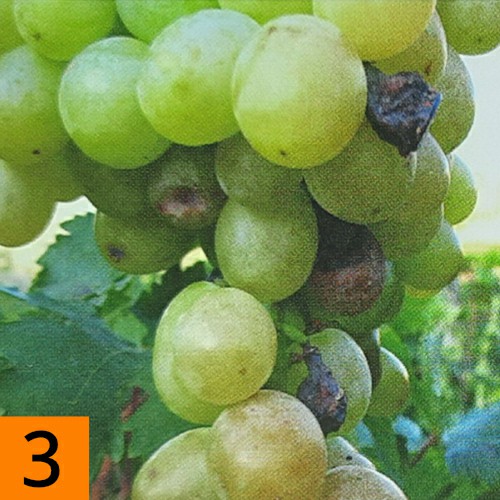
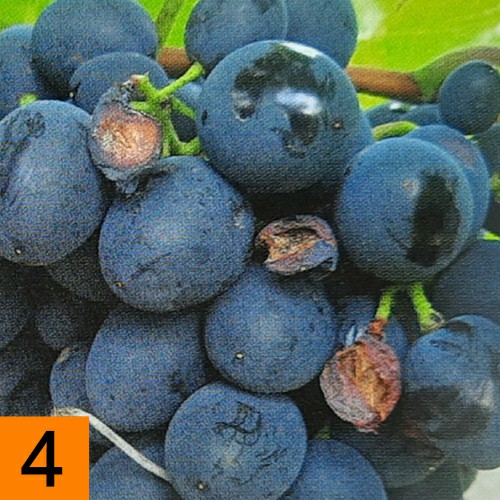
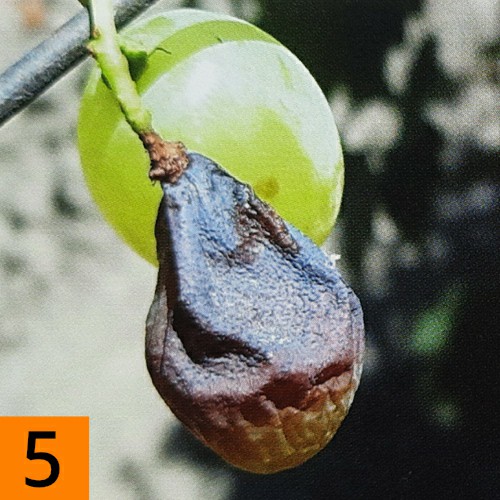
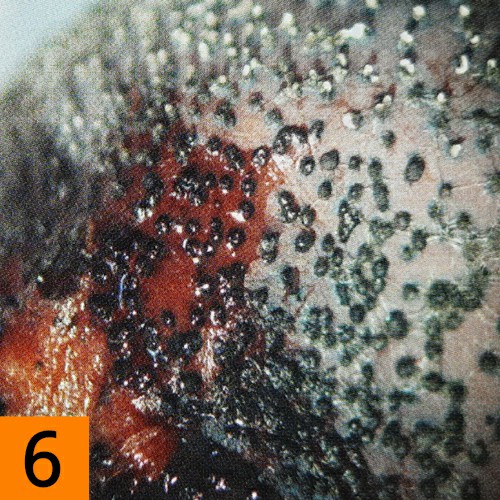
photo from the internet
DIAGNOSTICS
In spring, the first symptoms of the disease appear 15-20 days after infection on young leaves. Dry necrosis develops on the affected leaves in the form of round spots of cream or light brown color with a darker rim.
The diameter of the spots is 2-10 mm. In the center of the spots, pycnidia of the pathogen are formed, which look like black dots.
Young growing leaves are most susceptible to infection. The first symptoms appear in May-June. On all green parts of the plant, the disease manifests itself in the form of elongated spots, on which black pycnidia also form. On the affected berries, round, sunken dark blue or black spots are formed, which sometimes cover its entire surface, in their center a characteristic hole is formed (photo 1).
On the shoots, oblong spots of grayish, brown or black color are formed, on which black convex tubercles are visible - pycnidia (photo 2).
In dry and hot weather, the berries begin to dry out and wrinkle. Soon they mummify and acquire a blue-black color (photo 3, 4).
At high humidity wet rot of berries develops. The surface of the affected part of the skin is covered with numerous pycnidia (photo 5).
The pulp of the berry becomes brown and is filled with fungal hyphae (photo 6).
The rate of berry damage can be 2-3 days. A distinctive feature of black rot is that the affected berries do not fall off for a long time, but remain hanging on the bunches (photo 3).
Mass shedding of berries occurs mainly during the ripening period.
The diameter of the spots is 2-10 mm. In the center of the spots, pycnidia of the pathogen are formed, which look like black dots.
Young growing leaves are most susceptible to infection. The first symptoms appear in May-June. On all green parts of the plant, the disease manifests itself in the form of elongated spots, on which black pycnidia also form. On the affected berries, round, sunken dark blue or black spots are formed, which sometimes cover its entire surface, in their center a characteristic hole is formed (photo 1).
On the shoots, oblong spots of grayish, brown or black color are formed, on which black convex tubercles are visible - pycnidia (photo 2).
In dry and hot weather, the berries begin to dry out and wrinkle. Soon they mummify and acquire a blue-black color (photo 3, 4).
At high humidity wet rot of berries develops. The surface of the affected part of the skin is covered with numerous pycnidia (photo 5).
The pulp of the berry becomes brown and is filled with fungal hyphae (photo 6).
The rate of berry damage can be 2-3 days. A distinctive feature of black rot is that the affected berries do not fall off for a long time, but remain hanging on the bunches (photo 3).
Mass shedding of berries occurs mainly during the ripening period.
TREATMENT
The infection persists on the berries and on the affected vines, so they must be removed from the vineyard after pruning and destroyed.
The use of chemical methods of protecting grapes from black rot is currently most effective in vineyard areas where the disease was observed in the previous year; when there is a large amount of precipitation, specialized treatments are carried out from the stage of ovary formation until the berries close in the bunch.
The development of the disease is controlled by broad-spectrum drugs: Ditan M-45, SP, Ridomil Gold MC, Switch, Pergado M, Dinali, DK.
The use of chemical methods of protecting grapes from black rot is currently most effective in vineyard areas where the disease was observed in the previous year; when there is a large amount of precipitation, specialized treatments are carried out from the stage of ovary formation until the berries close in the bunch.
The development of the disease is controlled by broad-spectrum drugs: Ditan M-45, SP, Ridomil Gold MC, Switch, Pergado M, Dinali, DK.