Gray mold
GENERAL INFORMATION
The causative agent of the disease is Botrytis cinerea Pers, Ex Fr.
It is a conidial stage (anamorph) of a widespread microscopic mold in nature, known as Sclerotinia fuckeliana.
Crop losses from this disease can reach more than 80%.
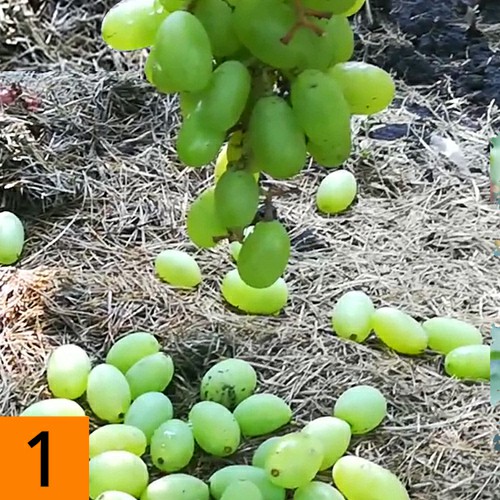
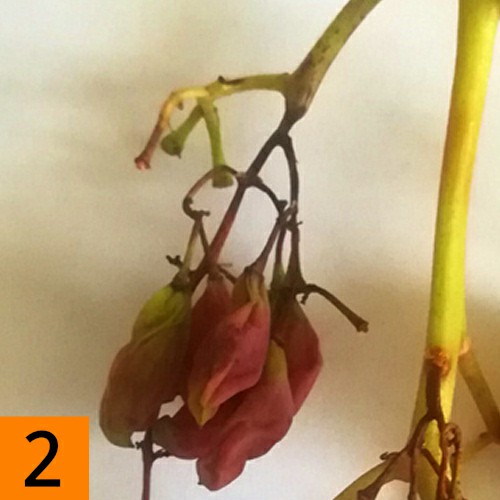

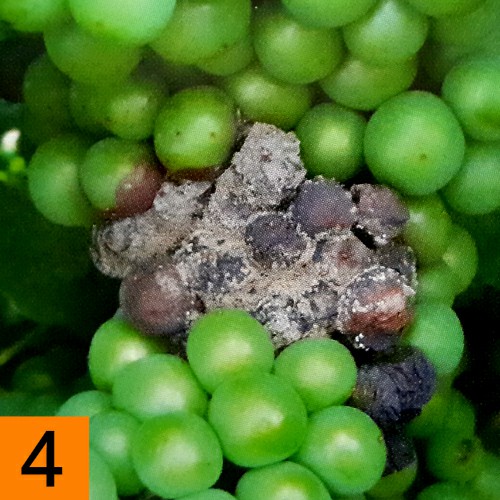
photo from the internet
DIAGNOSTICS
Defeat of shoots and leaves - appearance of brown spots covered with gray coating. It is rare on bushes, usually gray mold develops on combs and berries. If the fungus affects very young, newly formed berries, they die and fall off (photo 1).
At a later age, comb stems are infected. Depending on the air humidity, the affected areas can either dry out or rot.
In both cases, further nutrition of the bunch stops (photo 2).
The berries wither, the bunch or part of it breaks off and falls off (photo 3).
More dangerous is the defeat of ripening or mature berries. The fungus penetrates such berries through cracks in the skin, the mycelium developing inside the berry grows through its skin and penetrates into neighboring berries that do not have wounds (photo 4).
At a later age, comb stems are infected. Depending on the air humidity, the affected areas can either dry out or rot.
In both cases, further nutrition of the bunch stops (photo 2).
The berries wither, the bunch or part of it breaks off and falls off (photo 3).
More dangerous is the defeat of ripening or mature berries. The fungus penetrates such berries through cracks in the skin, the mycelium developing inside the berry grows through its skin and penetrates into neighboring berries that do not have wounds (photo 4).
TREATMENT
Chemicals should be applied in advance, regularly and almost until harvest.
The maximum frequency of treatments to protect against gray mold is four:
First - spraying with specialized fungicides against gray mold is carried out after the caps fall.
Second - before the berries close in the bunch.
Third - at the beginning of ripening.
Fourth - 2-4 weeks before harvest.
The main requirements for fungicides to protect against gray mold: they must be highly effective and have a short waiting period.
The shortest waiting period before harvesting are Switch and Horus.
Second - before the berries close in the bunch.
Third - at the beginning of ripening.
Fourth - 2-4 weeks before harvest.
The main requirements for fungicides to protect against gray mold: they must be highly effective and have a short waiting period.
The shortest waiting period before harvesting are Switch and Horus.