Oidium
GENERAL INFORMATION
Oidium is one of the main diseases of grapes.
The causative agent is Uncinula necator Burr. (marsupial stage, teleomorph), Odium tucken Berk, (conidial stage, anamorph).
It parasitizes only on living tissues of grapes.
The causative agent is Uncinula necator Burr. (marsupial stage, teleomorph), Odium tucken Berk, (conidial stage, anamorph).
It parasitizes only on living tissues of grapes.
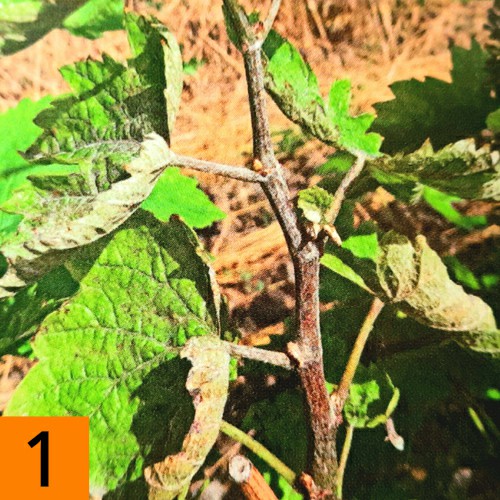
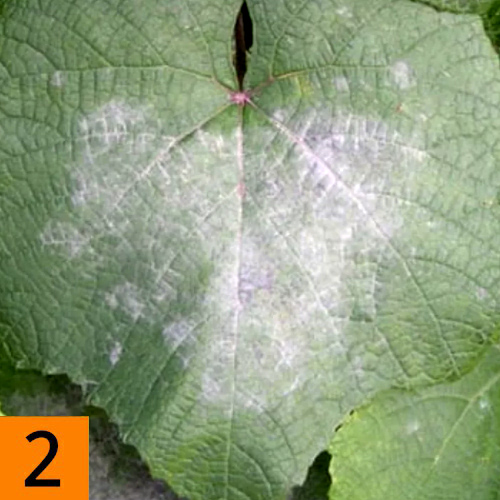
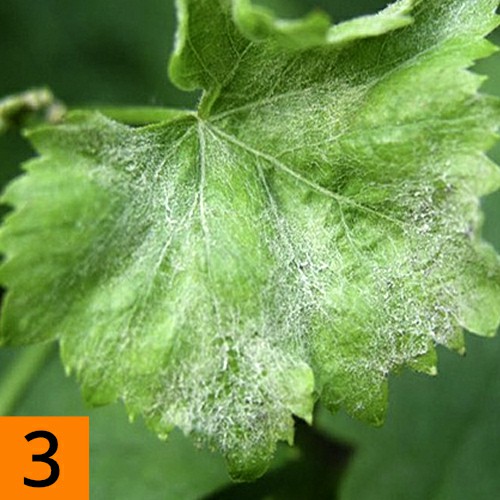
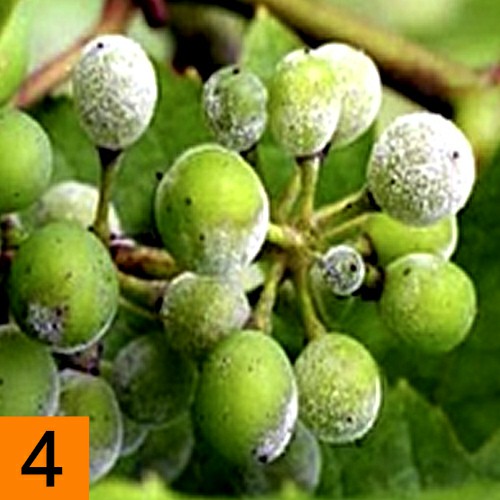
photo from the internet
DIAGNOSTICS
During the growing season, primary visual symptoms of the disease appear with the appearance of a white fungus and the release of "white flags" on the vine, the so-called "flag" shoots (photo 1).
Secondary infection with oidium on leaves appears as local chlorotic spots from a few millimeters to a centimeter or more with slight necrosis of the veins and a characteristic shine, they can appear individually or in groups and cover most of the leaf (photo 2).
Mycelium spreads along the surface of the substrate, forming a white and graying with age, clearly visible coating, often dense, felt-like (photo 3).
Necrotic spots develop on heavily affected leaves, they usually age prematurely and fall off. Inflorescences and growing berries are most susceptible to oidium damage (photo 4).
Secondary infection with oidium on leaves appears as local chlorotic spots from a few millimeters to a centimeter or more with slight necrosis of the veins and a characteristic shine, they can appear individually or in groups and cover most of the leaf (photo 2).
Mycelium spreads along the surface of the substrate, forming a white and graying with age, clearly visible coating, often dense, felt-like (photo 3).
Necrotic spots develop on heavily affected leaves, they usually age prematurely and fall off. Inflorescences and growing berries are most susceptible to oidium damage (photo 4).
TREATMENT
The most effective, economically and ecologically justified protection against powdery mildew is possible with mandatory 6-8 sprayings per season.
For protection against powdery mildew: from the triazole group - Topaz, Dinali traditionally sulfur preparations - Thiovit Jet from the strobilurin group - Quadris
For protection against powdery mildew: from the triazole group - Topaz, Dinali traditionally sulfur preparations - Thiovit Jet from the strobilurin group - Quadris