Rubella
GENERAL INFORMATION
Rubella has been known in vineyards for a long time.
The causative agent is the marsupial fungus Pseudopeziza tracheiphila Müller-Thurgau, which parasitizes mainly in the vessels, conducting bundles of the affected part of the grape leaf.
Rubella can remain latent in the affected plants for a long time and, when favorable conditions occur, cause a sharp outbreak of the disease.
The causative agent is the marsupial fungus Pseudopeziza tracheiphila Müller-Thurgau, which parasitizes mainly in the vessels, conducting bundles of the affected part of the grape leaf.
Rubella can remain latent in the affected plants for a long time and, when favorable conditions occur, cause a sharp outbreak of the disease.
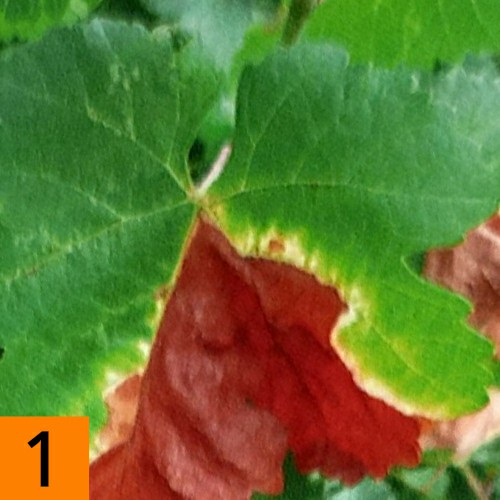
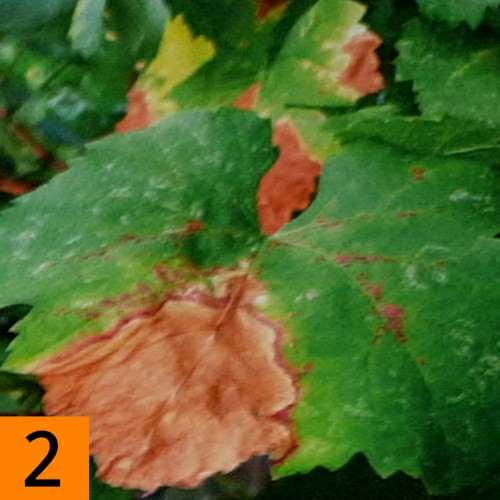
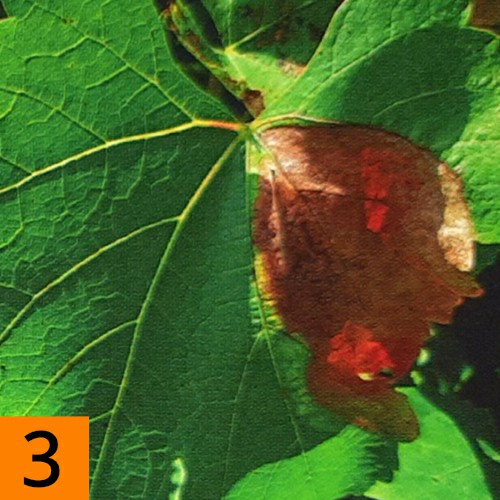
photo from the internet
DIAGNOSTICS
The disease mainly affects leaves. Young leaves, about 5 cm in diameter, are most susceptible to rubella.
The fungus causes light spots to appear on the first 4-8 leaves in late May - early June. 2-4 weeks after infection, the mycelium penetrates the vascular system and begins to destroy it, which leads to the following symptoms.
On the leaves of white grape varieties, the affected areas turn brown after a while, on dark varieties - ruby (photo 1) and later die off (photo 2).
Rubella spots are usually sharply limited by large and small veins of the leaf and have a wedge-shaped shape (photo 3).
In the initial stage, when they are at the edge of the leaf, they are difficult to distinguish from oily spots of mildew.
Symptoms of damage to young shoots are expressed in a slowdown in their growth. Damage to bunches is manifested in the massive shedding of berries as a result of weakening and destruction of the stalks.
The fungus causes light spots to appear on the first 4-8 leaves in late May - early June. 2-4 weeks after infection, the mycelium penetrates the vascular system and begins to destroy it, which leads to the following symptoms.
On the leaves of white grape varieties, the affected areas turn brown after a while, on dark varieties - ruby (photo 1) and later die off (photo 2).
Rubella spots are usually sharply limited by large and small veins of the leaf and have a wedge-shaped shape (photo 3).
In the initial stage, when they are at the edge of the leaf, they are difficult to distinguish from oily spots of mildew.
Symptoms of damage to young shoots are expressed in a slowdown in their growth. Damage to bunches is manifested in the massive shedding of berries as a result of weakening and destruction of the stalks.
TREATMENT
Measures to protect grapes from rubella come down to the implementation of a set of agrotechnical methods aimed at creating favorable conditions for the growth and development of plants and chemical protection from the disease using fungicides.
It is possible to carry out foliar feeding of affected vineyards with a solution of potassium nitrate.
Organic fertilizers also reduce the intensity of rubella development. Of the fungicides, the same preparations are effective against rubella as against mildew (Ridomil Gold MC, Pergado M, VDG, etc.).
Combined preparations with the obligatory presence of a good contact component have good effectiveness against the disease.
It is possible to carry out foliar feeding of affected vineyards with a solution of potassium nitrate.
Organic fertilizers also reduce the intensity of rubella development. Of the fungicides, the same preparations are effective against rubella as against mildew (Ridomil Gold MC, Pergado M, VDG, etc.).
Combined preparations with the obligatory presence of a good contact component have good effectiveness against the disease.